SD Card Reader for iPhone, Memory Card Reader with USB-C to Light-ning Adapter Plug and Play Trail Game Camera Micro SD Card Viewer Support SD/TF Card and USB for iPad No App Required (Black)





SD Card Reader for iPhone: A Plug-and-Play Bridge Between Cameras and Mobile Devices
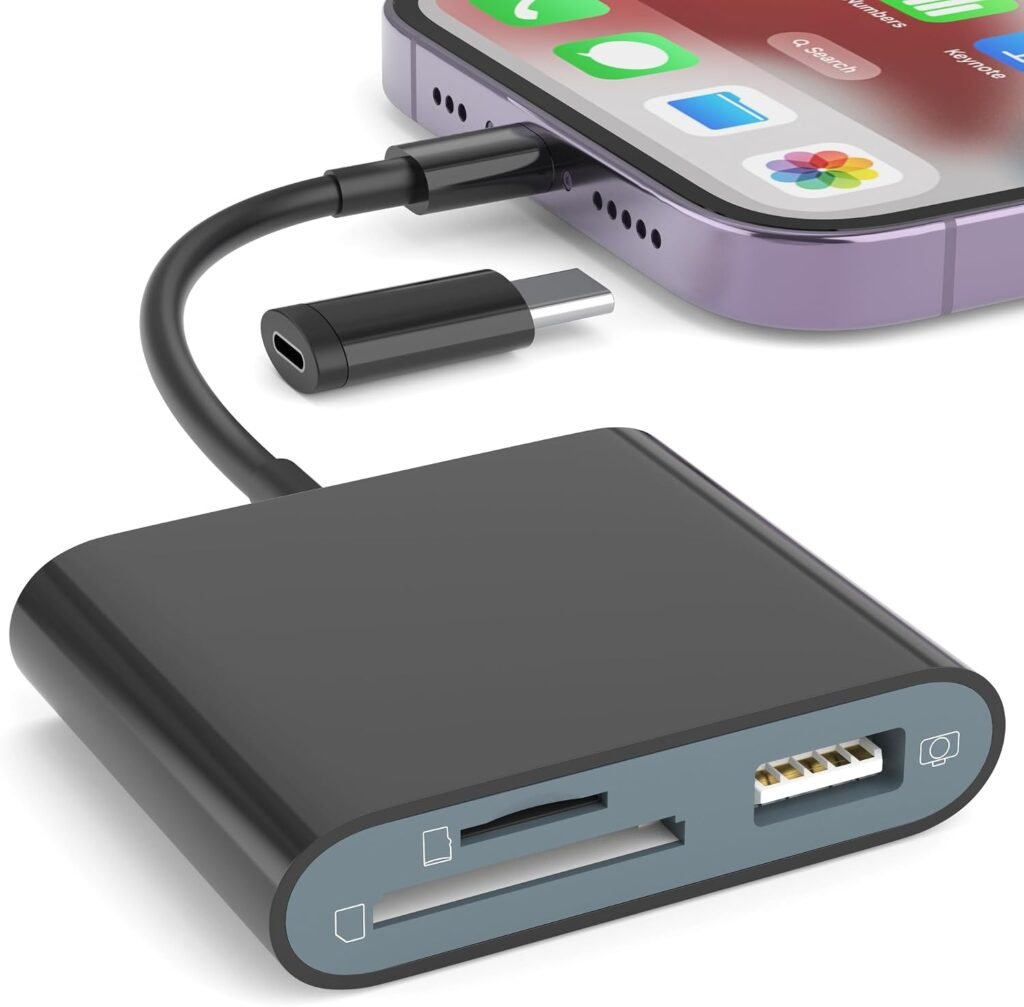
Moving photos and videos off a memory card usually means reaching for a laptop, locating a cable, and waiting through a slow transfer process. The SD Card Reader for iPhone from SZHAIYIJIN takes a different approach. It is a compact card reader built around a dual-connector design, pairing a USB-C plug with a detachable USB-C to Lightning adapter. The idea is straightforward: one small accessory that lets phones, tablets, and computers read SD and TF cards directly, without installing an app or removing the card from a camera.
This is a memory card reader aimed at photographers, trail camera users, dash cam owners, and anyone who regularly works with removable storage. It supports both standard SD and microSD (TF) cards, and it also includes a female USB interface that expands what the reader can connect to. Below is a closer look at how the pieces fit together and what the stated specifications mean in practice.
Design and Dual Connector Approach
The defining design choice here is the two-part connector system. The reader itself terminates in a USB-C connector, which plugs directly into modern devices such as the iPhone 15 and iPhone 16 series, USB-C iPads, Macs, Android phones, and PCs. For older Apple hardware, the package includes a detachable USB-C to Lightning adapter. Attaching that adapter converts the reader for use with Lightning-equipped iPhones and iPads.
That detachable arrangement matters because it separates the reader from a single ecosystem. Rather than buying one reader for an iPhone and another for a laptop, the same unit can move between iOS, Android, Windows, and macOS hardware. The source describes this as enabling cross-platform data transfers with full OTG support. The adapter is removable, which also means the Lightning portion can be set aside when it is not needed.
The reader is listed in black and includes dual card slots for SD and TF cards. It is described as supporting Secure Digital (Standard SD/SDHC) and Micro SD (TF) cards. One limitation is stated clearly: Wi-Fi SD memory cards are not supported.
Features and Technology
The core function is reading memory cards without an intermediary computer. Insert an SD or TF card, connect the reader to a phone or tablet, and the card’s contents become accessible. The source notes that no app download is required for the basic workflow.
Beyond card reading, the reader includes a female USB interface. This turns it into an OTG camera adapter for iPhone and iPad, supporting digital cameras and SLR cameras. The stated benefit is that there is no need to remove the camera’s memory card — the camera can be connected directly through its own cable. The same port accepts USB flash drives, card readers, USB headphones, electric guitars, and MIDI keyboards. There is a stated current limit: peripherals must not exceed 500 mA. Printers and hard disk drives are explicitly not supported.
Transfer support covers standard photo formats including JPEG and RAW, along with SD and HD video formats including H.264 and MPEG-4. The source describes this as high-speed data transfer, and notes that photos and videos can be moved to a device and shared to social media from wherever the user happens to be.
Performance and Everyday Experience
The practical value of a reader like this shows up in specific situations. A photographer shooting on a Canon or Nikon SLR can pull images onto an iPhone or iPad in the field rather than waiting to get back to a computer. The source describes a workflow where, about five seconds after inserting the memory card and connecting to the iPhone, the user opens the Photos app, finds “Import,” and brings videos and photos across. That is a short, direct path from card to device.
Trail camera and dash cam users get a similar benefit. Footage captured on a microSD card can be reviewed and shared without a laptop. The source frames this around sharing photos or videos quickly with friends or family while still out in the field.
The USB interface adds a second layer of usefulness. A USB flash drive can be read directly through the Files app, so files stored on a thumb drive become manageable from the phone. Keyboards and mice can also be connected, which the source presents as a way to type more easily. Two iPhones or iPads can be linked through a Lightning cable to share photos, and a digital camera can be connected through its own cable to read images directly.
Compatibility and Software Requirements
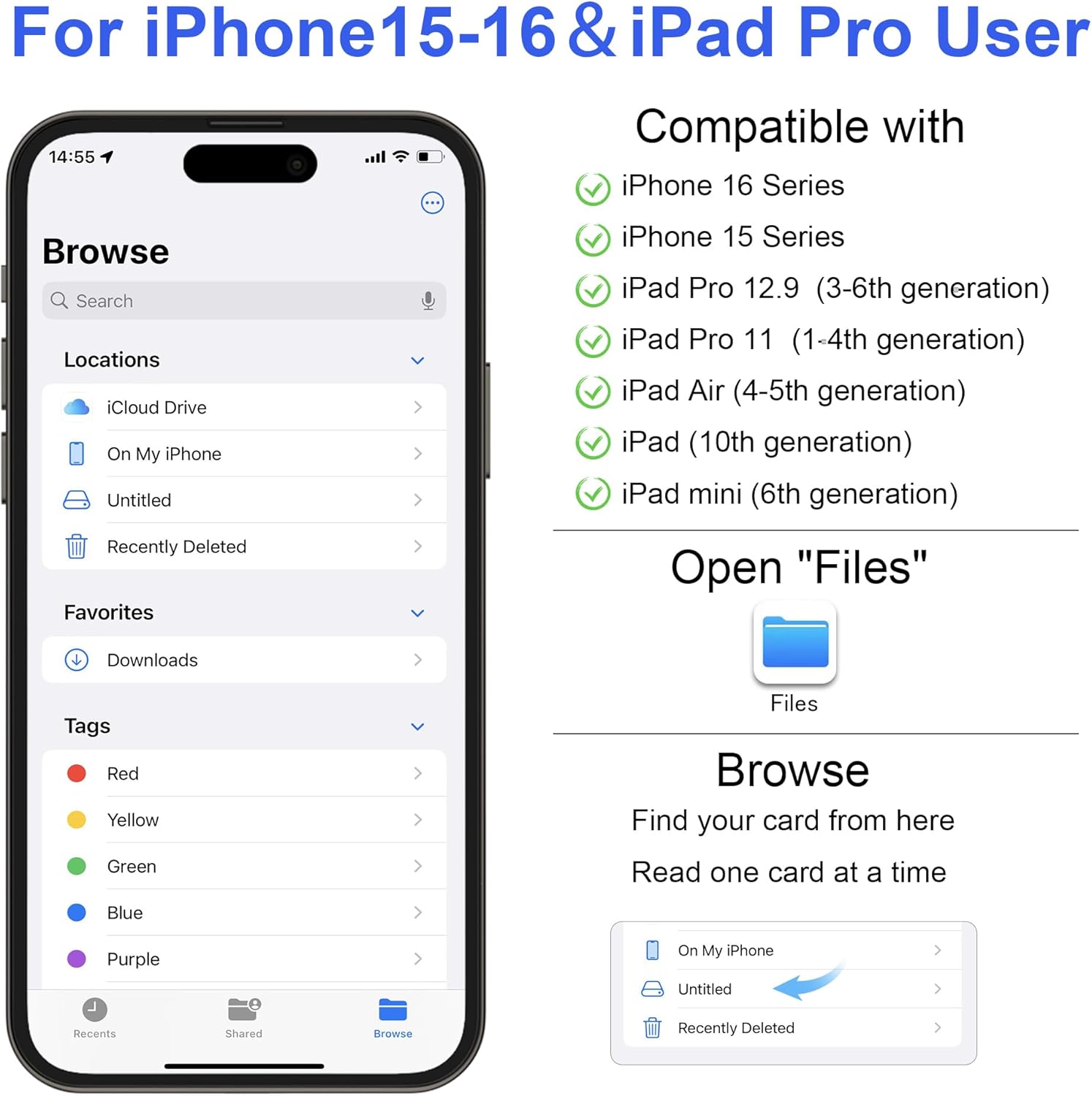
Compatibility is broad but version-dependent, and this is where buyers should pay attention. For Lightning devices, the source lists iPhone 5 through iPhone 14 series, along with iPad 5th through 9th generation, iPad Mini 1st through 4th generation, iPad Air 1st and 2nd generation, and iPad Pro 12.9-inch, 9.7-inch, and 10.5-inch models. For USB-C devices, the list includes iPhone 15 and iPhone 16 series, iPhone 17 models, iPad 10.9-inch 10th generation, iPad Pro 12.9-inch (3rd–6th generation), iPad Pro 11-inch (M4, M5), and iPad Air (M2, M3, M4). Mac support covers Mac Pro, Mac Mini, Mac Studio, iMac, MacBook, MacBook Air, and MacBook Pro across various model years. Android phones with a USB-C port are supported, provided the device supports OTG — the source specifically asks users to enable OTG on USB-C Android devices.
The software experience depends on the iOS version. On iOS 9.2 through 12.5.7, transfers run through the Photos app, which handles only photos and videos and works as a one-way transfer from card to iPhone. It also only reads photos or videos taken by a digital camera. On iOS 13 or later, the Files app takes over and enables two-way transfer, meaning files can move from card to iPhone or iPad and back again. The Files app handles a wider range of file types, including music, PDF, Word, and Excel documents, and the source states two-way transfer is suitable for iOS 13 through 18.
A few practical notes are worth repeating. The memory card must be formatted as FAT32 or exFAT; NTFS cards will not be recognized. The Files app does not open automatically, so users need to launch it and look under “On My iPhone” for the card, which typically appears as “Untitled” or “NONAME” unless it has been renamed. Some file types may require a third-party app to open, similar to how a computer needs the right software to play a given file.
Who Is This Product Best For?
This reader suits people who shoot on SD or microSD cards and want to review or share that content from a phone or tablet. Photographers using SLR or digital cameras, trail camera owners, and dash cam users are the clearest fits based on the stated use cases. It also works for anyone who wants to read a USB flash drive or connect a keyboard or mouse to an iPhone or iPad.
Because the reader spans both Lightning and USB-C through its detachable adapter, it is a reasonable option for households with a mix of older and newer Apple devices, or for users who move between an iPhone, an Android phone, and a Mac. Buyers with iOS 13 or later get the fuller two-way transfer experience, while those on older iOS versions should expect the more limited Photos app workflow.
Final Verdict
The SD Card Reader for iPhone is a focused accessory that solves a common problem: getting files off a memory card without a computer. Its dual-connector design, detachable Lightning adapter, dual card slots, and female USB interface give it more flexibility than a single-purpose card reader. The stated format support for JPEG, RAW, H.264, and MPEG-4 covers typical camera output, and the Files app workflow on iOS 13 and later allows two-way transfers across a range of file types.
The caveats are clearly stated rather than hidden. Wi-Fi SD cards are not supported, NTFS-formatted cards will not be recognized, peripherals must stay under 500 mA, and printers and hard drives are excluded. Older iOS versions get a narrower, one-way photo and video workflow. For users who understand those boundaries, this reader offers a practical way to move photos, videos, and files between cameras, cards, and mobile devices.
View on Amazon